

Slope. Settlement. Convergence.
One Sensor. Three Modes.
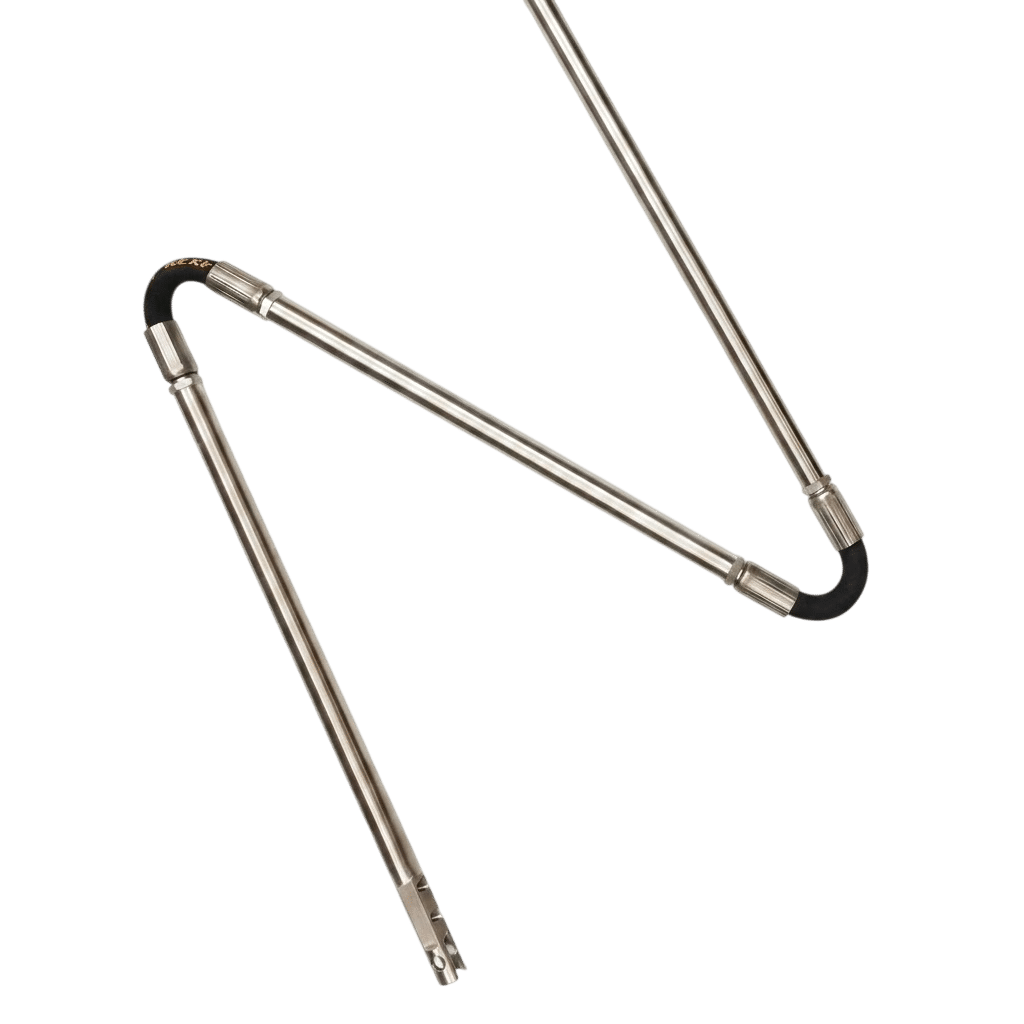
Ackcio GeoArray is a wireless in-place displacement array for vertical, horizontal, and arch installations. It outputs ready-to-use engineering values in millimetres — no laptop at the datalogger, no proprietary post-processing software, no recurring fees.
Still Relying on Manual Readings and Laptop-Based Post-Processing?
Traditional ground displacement monitoring is built on compromise. Automated alternatives improved frequency — but most still require a laptop at the datalogger to turn raw data into usable results.
Manual site visits for data collection
Sending a technician to lower a probe, take readings at each depth, and return with results. Costly, risky in hazardous sites, infrequent at best.
Proprietary software locks your data
Most shape arrays force you through vendor-specific desktop software to convert raw tilt into displacement — before your team can even open the file in something useful.
Recurring fees and vendor lock-in
Annual software licences, per-sensor cloud charges, and proprietary loggers add up — and tie you to one vendor's ecosystem for the life of the project.
What if the sensor processed displacement onboard, streamed engineering values wirelessly to a single dashboard alongside your other sensors, and never sent you a renewal invoice?
That’s exactly what GeoArray does.
From Ground Movement to Edge Dashboard
Each segment computes displacement at the edge. No laptop. No post-processing software. Just ready-to-use data, 24/7.
GeoArray Sensor
Triaxial MEMS tilt per segment
Onboard Processing
Raw data → X/Y/Z displacement
Digital Node
RS-485 to wireless datalogger
Beam Mesh
Wireless network through site
Snape Dashboard
Real-time edge monitoring
Built for the Way Geotechnical Engineers Actually Work
Sub-millimetre accuracy is table stakes — you'll find the numbers in the specs. What sets GeoArray apart is everything around the data: how you install it, what you have to do to use it, and what it costs to keep running.
Three Modes From One Sensor
Vertical for slope and lateral movement. Horizontal for settlement, heave, and shear. Arch for tunnel and underground convergence. The same BEAM-GA hardware does all three — simpler procurement, less training, fewer spare parts on site.
Slope • Settlement • ConvergenceOne-Piece Construction — No Field Calibration
Lower the array into casing as a single sealed unit. No segment-by-segment assembly on site. No alignment routine. No water-ingress points to manage. Smaller crew, faster install, fewer commissioning errors.
Faster installEngineering Values Out — No Math In
Each segment processes raw tilt into X/Y/Z displacement onboard, in millimetres. Your dashboard receives ready-to-use values — no laptop at the datalogger, no proprietary post-processing software, no conversion formulas for your team to maintain.
#1 DifferentiatorNative Wireless via Beam Mesh
Built into the Ackcio Beam Mesh network from the ground up. Data flows from sensor to the edge platform without wired telemetry trenches, fibre runs, or cellular modems at every datalogger.
One Platform for Every Geotechnical Sensor
GeoArray connects via RS-485 to the Ackcio Digital Node — joining the same Beam Mesh network and Snape dashboard as your vibrating-wire, analogue, and tilt sensors. One wireless backbone. One source of truth. One vendor to call when something needs attention.
Unified Ackcio ecosystemZero Subscriptions, Zero Lock-In
One-time hardware purchase. Snape edge dashboard and Nimbus mobile app included. No recurring licence fees, no per-sensor software charges, no vendor lock-in — you own the full monitoring stack from day one.
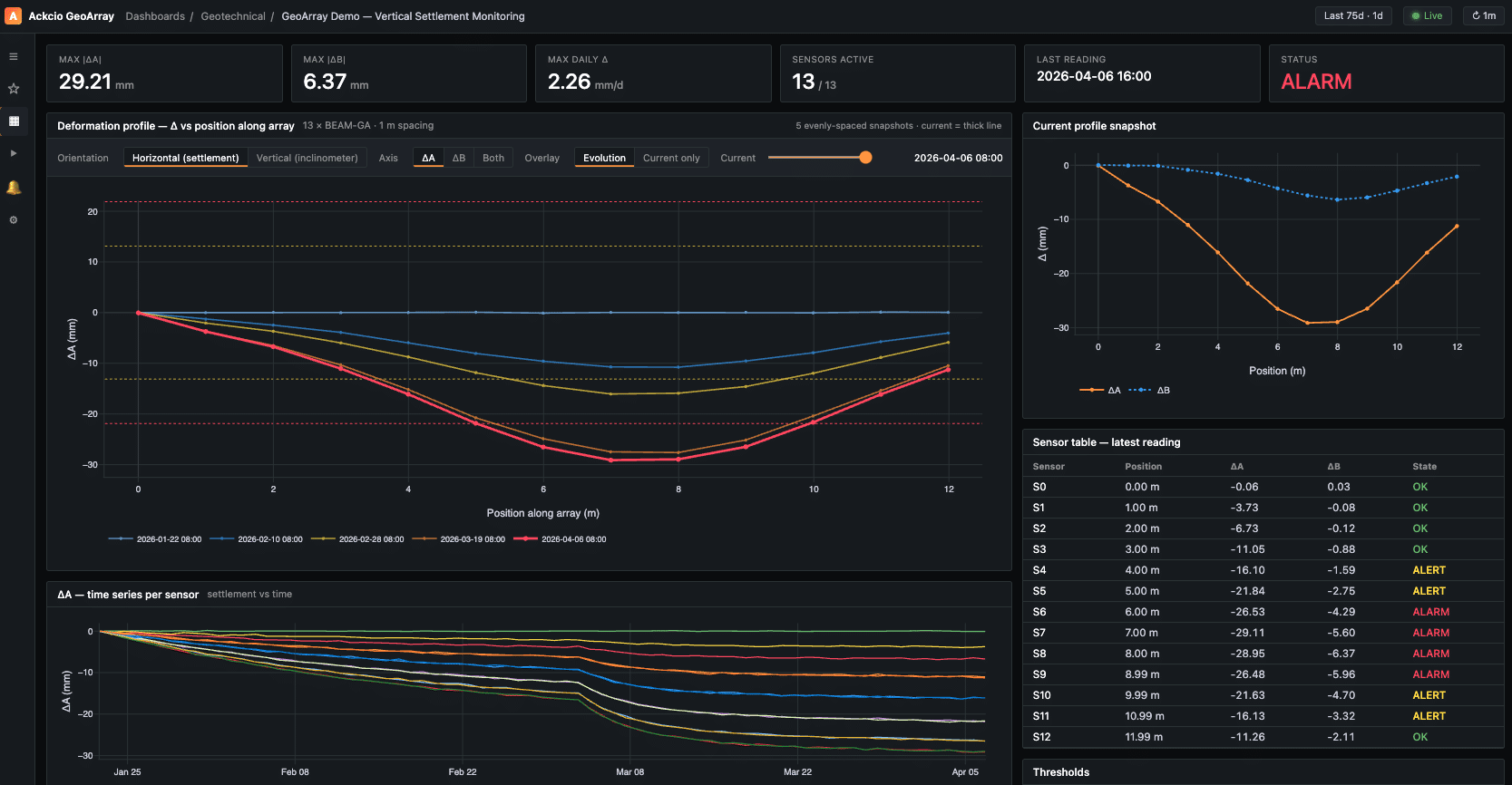
$0 recurringFrom Borehole to Browser — Real Displacement, Real Time
No spreadsheets to wrangle. No raw-tilt files to convert. GeoArray streams engineering-ready X/Y/Z displacement profiles into your Snape dashboard so you can act on what the ground is doing now — not what it did last week.
GeoArray vs. Traditional In-Place Inclinometers
A note on this comparison: GeoArray is a continuous displacement array providing full deformation profiles, while IPI measures discrete points. This is an apples-to-oranges comparison — but we know many teams weigh these options side by side, so here are the facts.
| Capability | GeoArray | Traditional IPI |
|---|---|---|
| Measurement Type | ✔ Continuous profile (every 0.5 m) | Discrete point measurements |
| Data Processing | ✔ Onboard — automatic | Requires laptop post-processing |
| Data Transmission | ✔ Wireless via Beam Mesh to the Ackcio edge platform | Wired telemetry to datalogger |
| Installation Modes | ✔ Vertical, horizontal, and arch | Vertical only (typically) |
| Displacement Resolution | ✔ 0.01 mm | Varies by manufacturer |
| Site Visits for Data | ✔ None required | Periodic maintenance & retrieval |
| Subscription Fees | ✔ Zero — one-time purchase | Varies; often includes licences |
| Casing Compatibility | 70 mm inclinometer casing | Multiple sizes available |
| Operating Temperature | ✔ −40°C to +85°C | Varies by manufacturer |
Tier-1 3D Displacement Performance
Without the Tier-1 Price
Engineers shouldn't have to choose between accuracy and budget. GeoArray delivers shape-array-grade performance — sub-millimetre resolution, full deformation profile, three installation modes — at a price your QS will actually approve. Made for the way modern monitoring contracts are scoped.
Segment options to fit any budget
Recurring software fees, ever
Three installation modes from one product
Pick the Segment Length That Fits Your Project
Tighter segments mean a finer deformation profile. Longer segments mean fewer parts and lower cost per metre. Mix and match across your portfolio — the data interface and dashboard stay identical.
0.5m
High-resolution profile
1.0m
The standard workhorse
2.0m
Long-array, lowest cost/m
Need a vertical-only configuration? BEAM-GA-V is available as a streamlined SKU. Talk to a specialist →
Full Specs
All values from the Ackcio GeoArray (BEAM-GA) Datasheet, November 2025.
| Sensor Type | MEMS Tilt Sensor (tri-axis) |
| Measurement Axes | X, Y, Z (3D displacement) |
| Segment Length | 0.5 m or 1.0 m |
| Max Measurement Length | 100 m (0.5 m) / 200 m (1.0 m) |
| Angle Range | 360° |
| Angular Resolution | 0.001° |
| Angular Accuracy | ±0.005° |
| Displacement Resolution | 0.01 mm |
| Stability | ±1.0 mm @ 50 m |
| Temperature Drift | <1 mm @ 50 m (−20 ~ +55°C) |
| Long-term Stability | 0.05° drift over 10 years |
| IP Rating | IP68 |
| Pressure Rating | 2 MPa standard / 4.5 MPa high-pressure |
| Operating Temperature | −40°C to +85°C |
| Construction | Stainless-steel segments with flexible joints |
| Casing Compatibility | 70 mm inclinometer casing (vertical) |
| Horizontal Casing | ≥70 mm (flexible with securing methods) |
| Interface | RS-485 → Ackcio Digital Node |
| Supply Voltage | DC 5–30 V |
| Average Current | ≤ 2.5 mA @ 12 V per segment |
| Peak Current | 4 mA @ 12 V per segment |
| Power Formula | 15 mA + (N × 2.5 mA) @ 12 V |
| Battery Limit | ≤ 70 segments |
| External Power | > 70 segments supported |
Where GeoArray Works
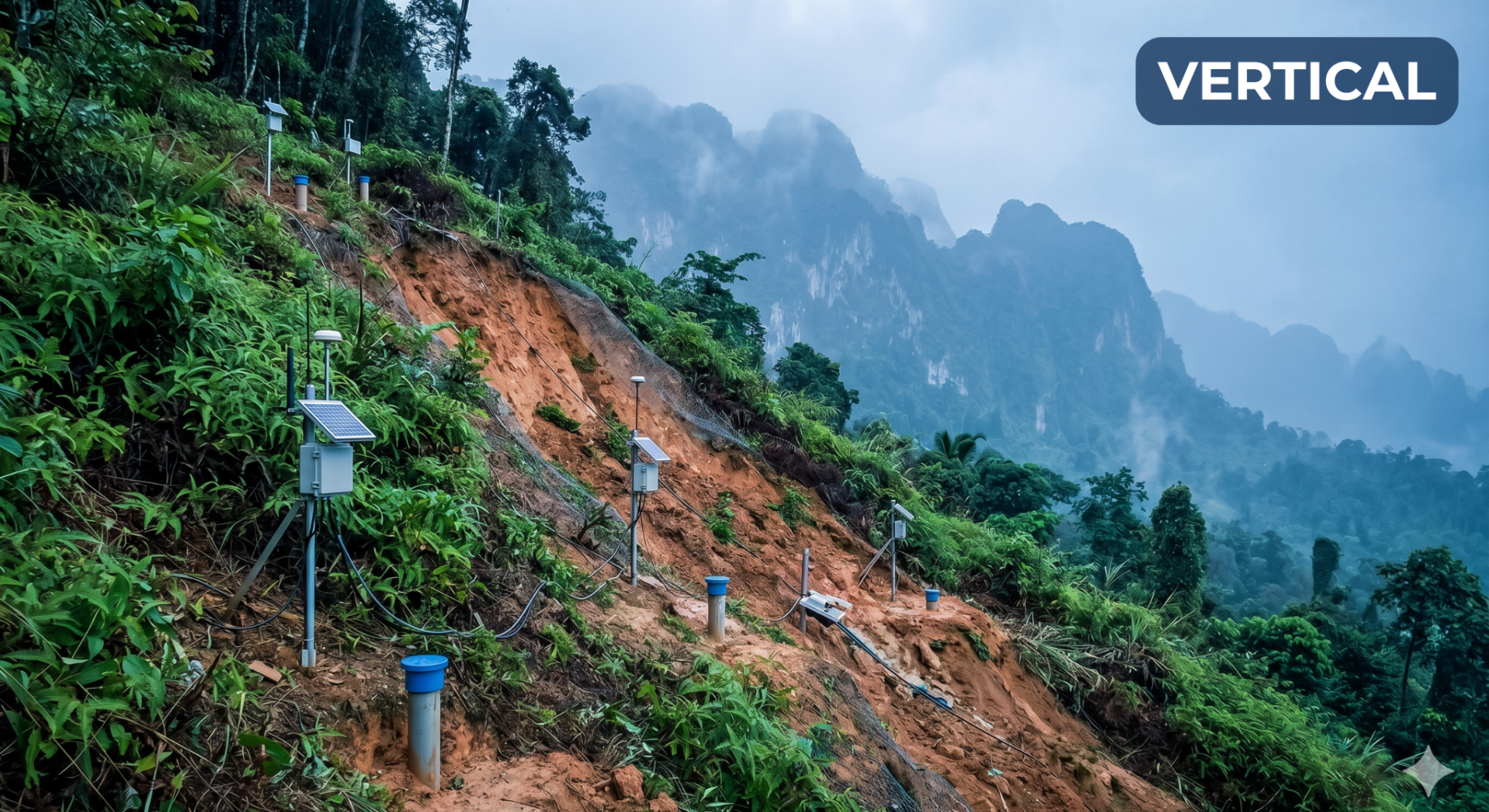
Slope Stability & Landslide Warning
Continuous monitoring of subsurface lateral displacement in hillside boreholes. Detect creep and shear-zone development long before surface signs appear — critical for highway cuts, mining benches, and natural slopes.

Deep Excavation & Retaining Walls
Vertical GeoArray in boreholes adjacent to diaphragm walls, secant pile walls, and braced cuts. Real-time 3D deformation profiles throughout the full excavation depth — basement boxes, station boxes, deep shafts.
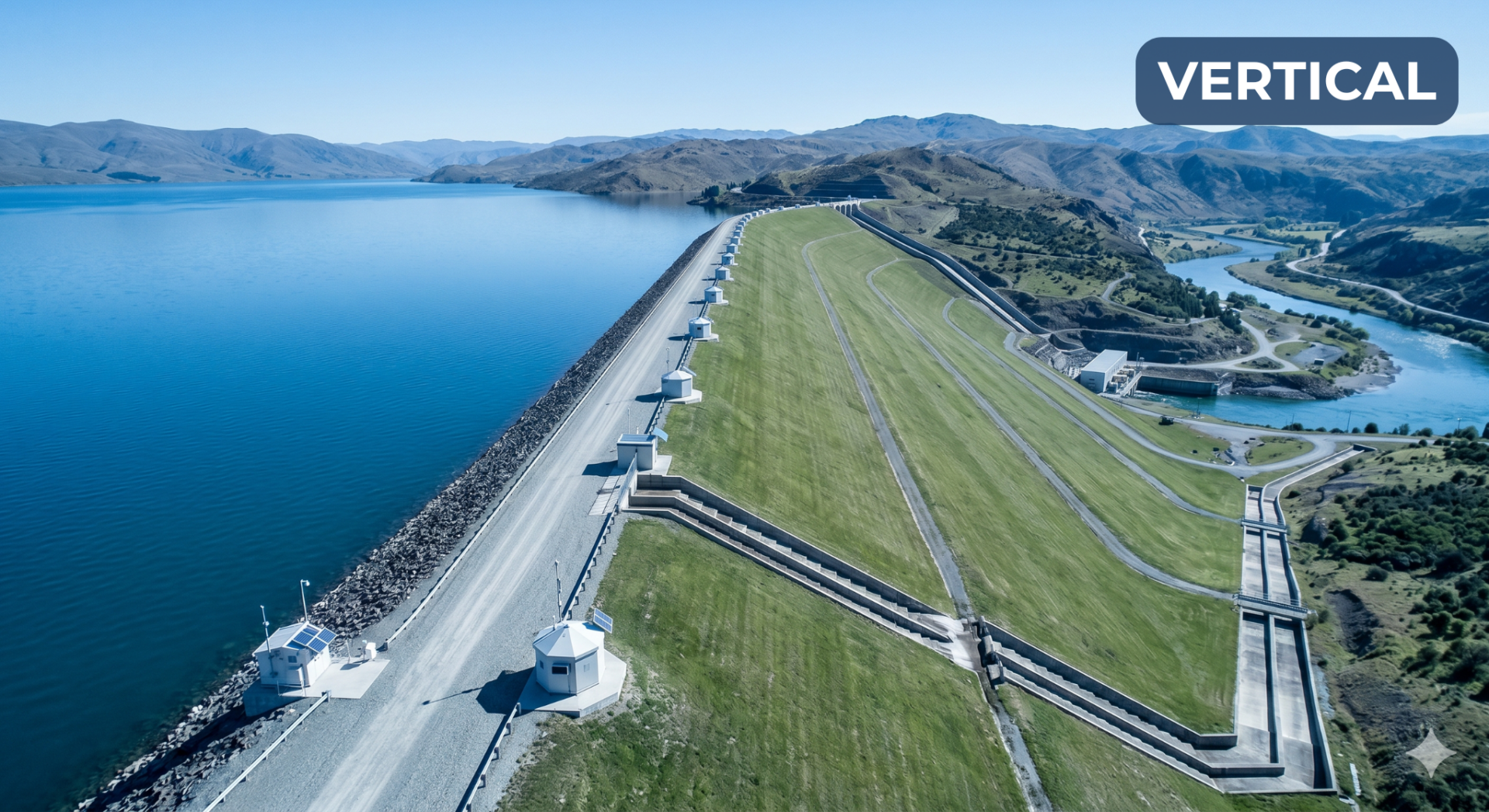
Tailings Dam Monitoring
Built for GISTM-aligned tailings storage facility (TSF) monitoring. Vertical arrays in the embankment crest and downstream berms; horizontal arrays beneath starter dams. Continuous data feeds your TARP triggers and EOR reviews.
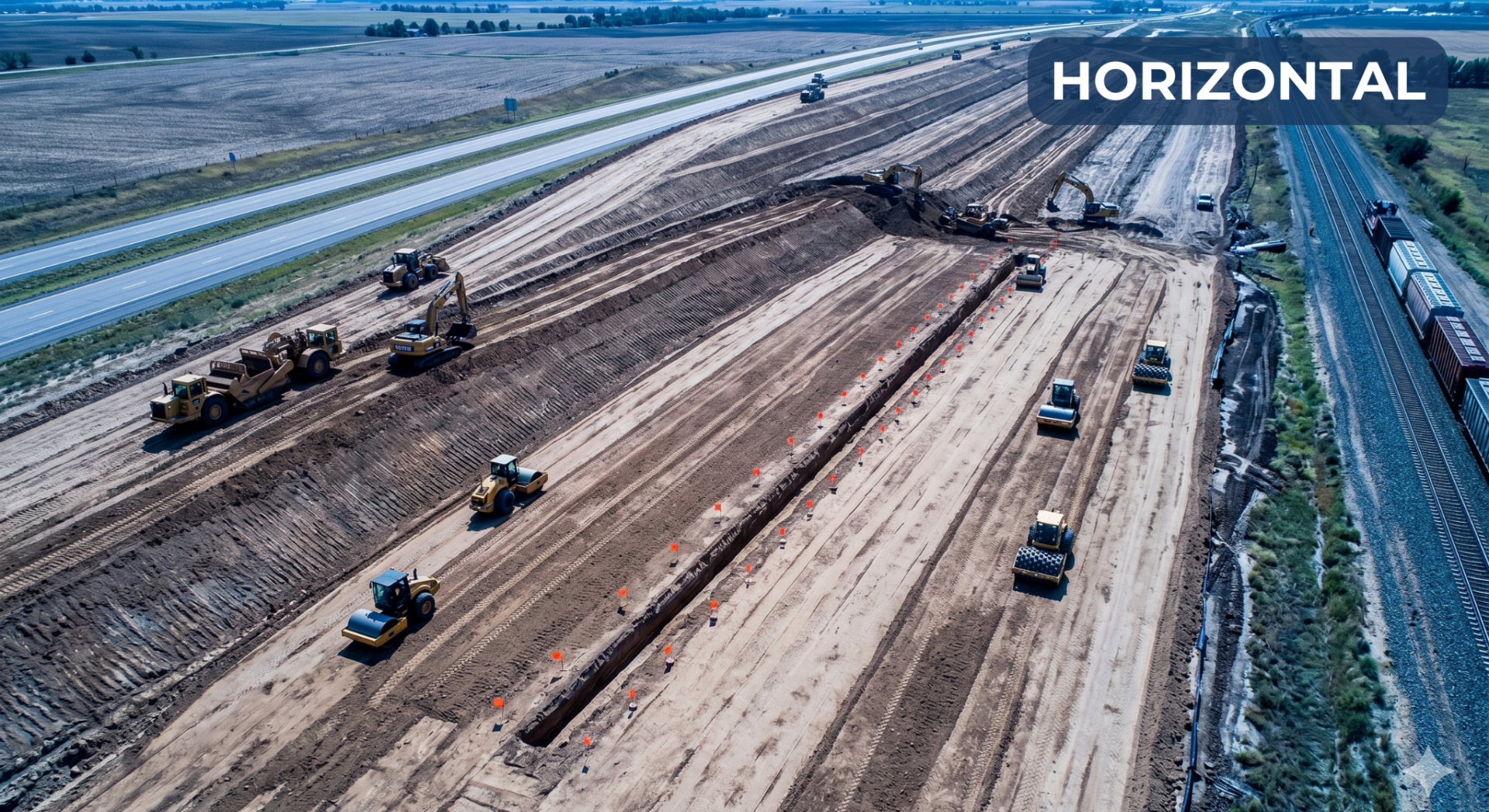
Settlement, Embankment & Track Monitoring
Horizontal GeoArray buried under platforms, fills, and rail formations. Captures settlement, heave, and shear along the full trench length — high-speed rail, MRT alignments, port platforms, runway extensions.

Rail Track Settlement
GeoArray under the track formation captures continuous settlement and heave along the full alignment — critical when tunnelling, deep excavation, or adjacent construction puts operating MRT, high-speed rail, or freight lines at risk.
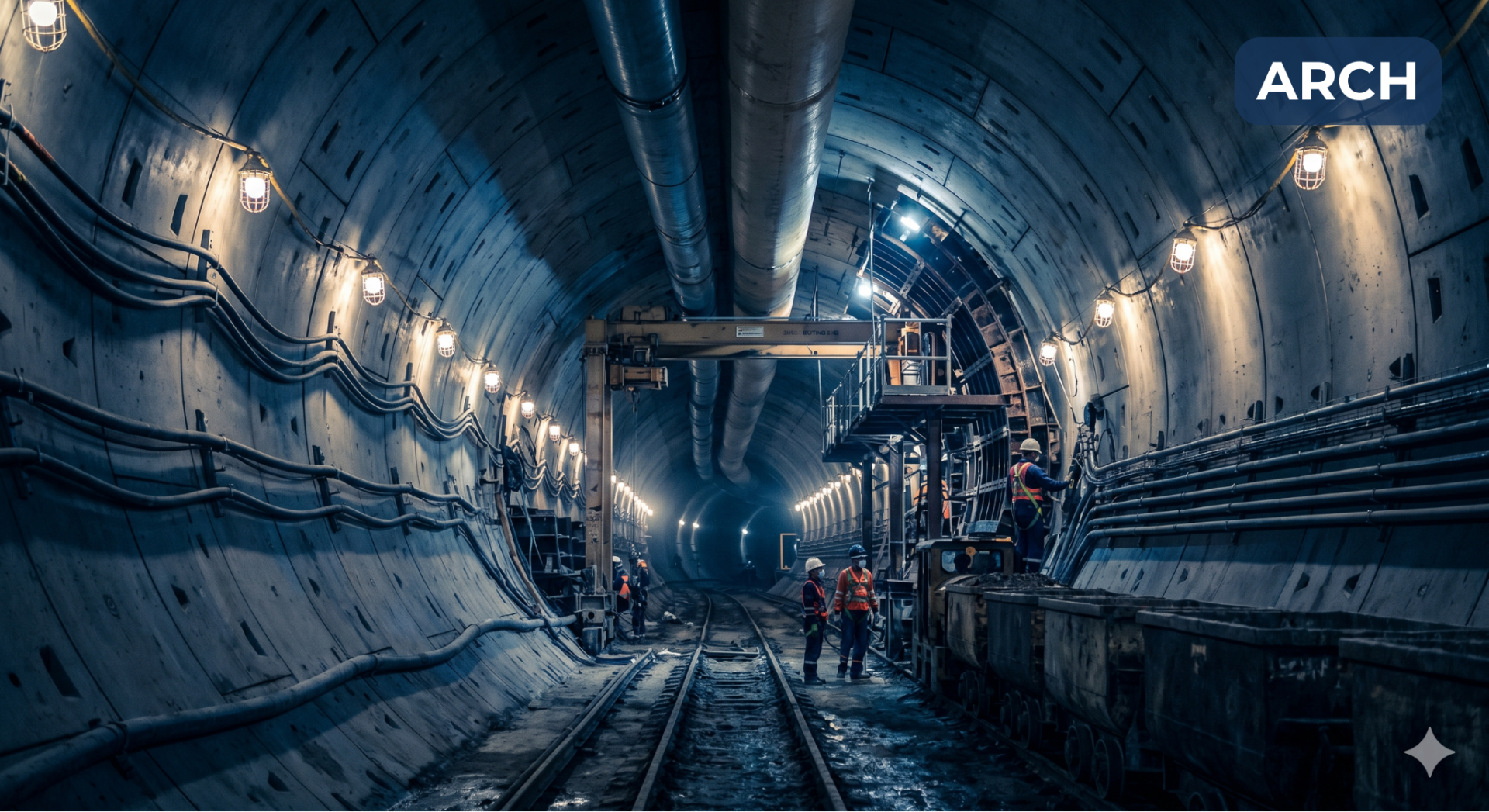
Tunnel & Underground Convergence
Mounted along the inner arch with stainless-steel saddle clamps. Full deformation profile vs. isolated prism measurements — ideal for MRT tunnels, road tunnels, hydropower headrace, and station box linings.
Part of the Ackcio Monitoring Platform
GeoArray isn’t a standalone sensor — it’s a native part of the Ackcio platform. Same wireless network, edge dashboard, and mobile app across all Ackcio sensors.
Ackcio Digital Node
Receives processed data from GeoArray via RS-485 and transmits wirelessly through Beam Mesh.
BEAM Gateway
Forwards wireless data to the ackcio edge platform via cellular or ethernet connectivity.
BEAM Repeater
Extends wireless mesh range in tunnels, deep sites, or large-area deployments.
Snape Dashboard
Edge-based monitoring with real-time alerts, data visualisation, and reporting.
Nimbus Mobile App
On-site sensor configuration, status checking, and data preview from your phone.
Beam Mesh Network
The proprietary wireless protocol connecting all Ackcio sensors. GeoArray is a native Beam Mesh device.